Acquire
Introduction
In essence, single-camera, multi-light capturing hardware consists of a camera and one or more light sources of which the position can be calculated or is known.
RTI

Example of an RTI dome as produced by custom-imaging.co.uk (their Dome 7).
There is a large variety of scanning equipment available, but in essence, both PLD and RTI require a set of images of an object that is illuminated from various known directions. RTI has 2 types of recording equipment: The dome setups and the highlight RTI setup. The dome setup functions in the similar manner as the PLD domes.
Highlight RTI utilizes chrome/specular spheres to estimate the direction of a point light source (e.g. a flash). This technology is typically cheaper and more flexible in terms of object size to be scanned; for a manual to the procedure see [CHI2013]. The downside is that it generally is slower, requires more intervention and is less accurate, as light sources have to be calculated using the specular reflection in the reflective spheres.
PLD
There is a large variety of scanning equipment available, but in essence, both PLD and RTI require a set of images of an object that is illuminated from various known directions. PLD has a set of scanning domes, both with white light LEDs as well as narrow band near infrared, red, green, blue and near ultra violet light LEDs for multi spectral recordings. Can be listed:
White Light Mecano Minidome | Multispectral Minidome | White Light Microdome | Multispectral Microdome
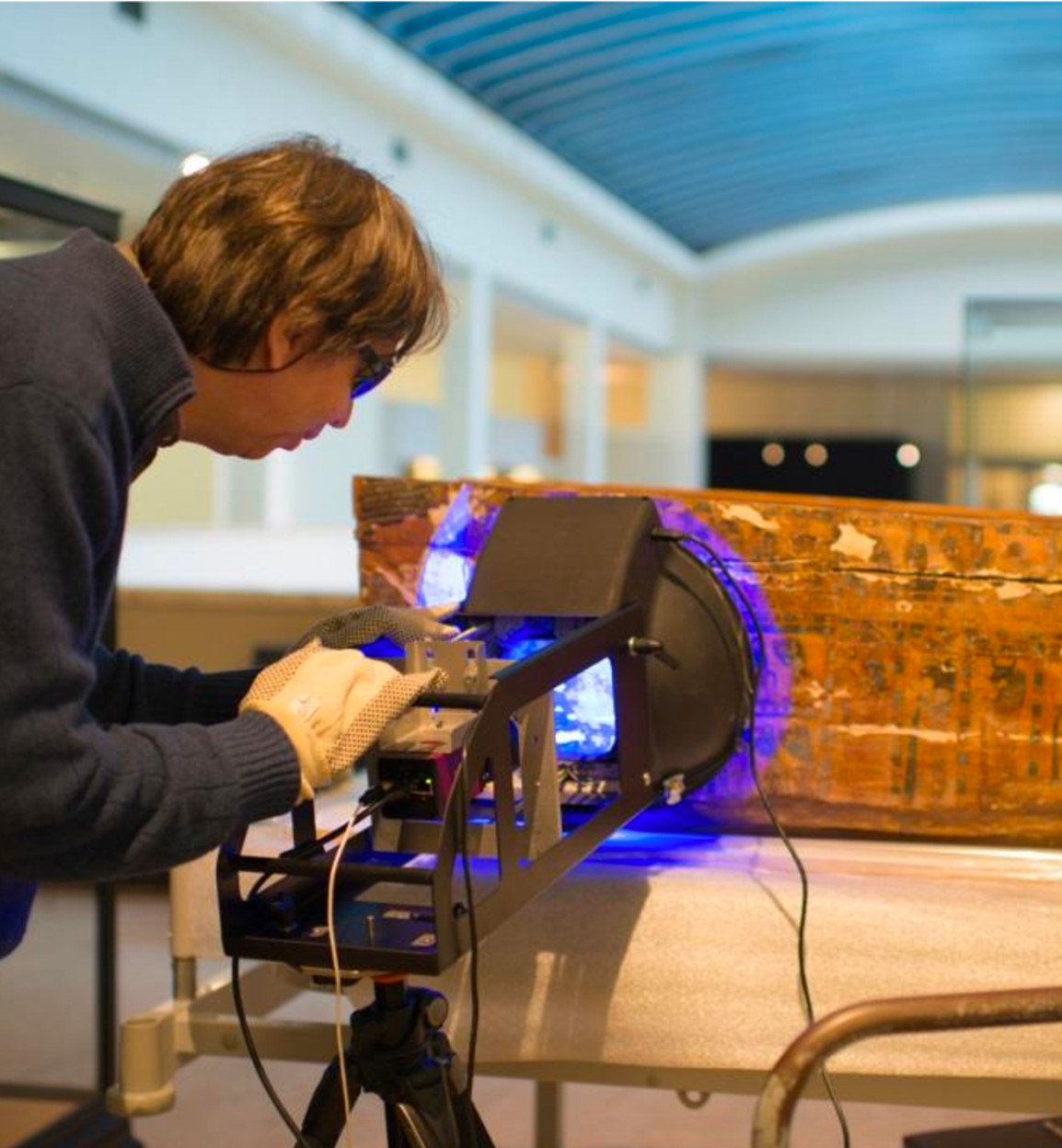
Use of multispectral microdome (PLD system) to scan an Egyptian coffin (@ Art and History Museum, Brussels)